Helping the counseling profession meet its future without losing its heart.
Dr. Michael Jones integrates technology into mental health systems, and has for fifteen years: telemental health before the world needed it, AI now that it does. He speaks, teaches, and consults in counseling rooms, classrooms, sanctuaries, and summits. One commitment: care that stays human.
Keynotes, workshops, webinars, and consultation for universities, conferences, and mental health organizations. Ethics, AI, telemental health, supervision, and culturally responsive care, delivered by someone who has spent two decades in the field and still teaches it every week.
Continuing education through the Counselor Education Collective, including the AI Care Ethics Certificate, a six-hour, NBCC-approved certificate program built specifically for counselors and grounded in care ethics, and the Telemental Health Provider Training that prepares you for the BC-TMH credential. Built for real practice, not checkbox CE.
Consulting for technology companies, public agencies, and international bodies adopting AI faster than they can answer for it. A care ethics framework, and the mental health, BIPOC, and spiritual perspectives the AI conversation is missing.
Counselor education is home base, and the conversation travels well beyond it, into higher education, technology and policy, and faith communities.
20+Years of clinical practice
Tens of ThousandsTrained in tech-integrated care across courses, CE, and conferences
100+Conference presentations
More than 25Peer-reviewed publications
Consulting & Tech Integration
The voice that's missing from the AI table.
Dr. Jones integrates technology into mental health systems, and has for fifteen years. As AI gets adopted faster than it is understood, in products, public agencies, and whole systems of care, he consults where the decisions get made, bringing a relational care ethics framework from his scholarship and the mental health, BIPOC, and spiritual perspectives the global AI conversation has been missing.
Technology Companies
Build systems that know they touch people.
For product and AI teams whose tools reach human minds: care ethics in design, informed consent language, cultural responsiveness, privacy guardrails, and the moments where software should hand a person back to a person.
Government & Public Agencies
Adopt fast without abandoning judgment.
Agencies are moving on AI at remarkable speed. Dr. Jones brings a framework for what to automate, what to keep human, and how to train staff for both. He already works with state agencies, including the Alabama Department of Mental Health.
International & Policy Bodies
Three perspectives, one seat.
Standards and governance conversations shape how billions will meet AI in their most vulnerable moments. Dr. Jones brings a clinician's evidence, Black mental health scholarship, and a voice grounded in faith communities to summits and convenings.
Executive coaching is an ongoing partnership for leaders navigating decisions, culture, and the daily weight of the work. It draws on the same twenty years of clinical and organizational experience Dr. Jones brings to consulting, structured around the goals you bring to it, and delivered with direct candor.
How It Works
Regular sessions, real accountability.
One-hour video sessions on a set cadence, usually every other week, for an initial term you agree to up front. Built around the goals you bring to each conversation.
Not Counseling
Coaching, not treatment.
This is not therapy, and it is not a single consulting engagement. It is a standing partnership focused on your leadership and decision-making, kept separate from any clinical work.
Who It’s For
Leaders carrying real weight.
Executive directors, founders, and leaders in mission-driven organizations who want a steady, candid partner for the decisions that do not have easy answers.
Inquire about coachingGrounded in the same relational, care ethics-centered approach featured throughout his work.
About
The professor people stay to talk to afterward.
Dr. Michael Jones is a counselor educator, licensed professional counselor supervisor, and tenured professor who has spent his career where the counseling profession is headed next. He was teaching telemental health ethics a decade before the pandemic made it urgent. Today he brings that same early clarity to artificial intelligence, helping counselors engage new tools without surrendering relational integrity.
The headline is literal. In his online classrooms, class ends the way good gatherings end: with the After Party, an open, unhurried space where students stay on after the formal hour to keep talking. It looks casual. It is purposeful, relational-cultural theory put into practice, built on the conviction that connection is what makes learning hold. He wrote about the model in the SACES Newsletter, and faculty across programs have adopted it for their own courses.
His scholarship and speaking center three commitments: ethical grounding, cultural responsiveness, and practical literacy with the technologies entering the counseling room. He is co-editor of Mental Health and the Black Man: A Mixtape Experience of Hardship and Harmony, a former president of both SACES and the Arkansas Counseling Association, and a longtime voice in national conversations on ethics through service on the ACA Ethics Committee.
He is a tenured professor of counseling. For an African American man in the academy, tenure remains rare, and Dr. Jones names that openly rather than treating it as a footnote. His scholarship on the absence of Black men in counselor education began with a question he has carried his whole career: who gets to sit in rooms like this one, and what it takes to hold the door open behind you.
Twenty years of clinical practice sit underneath everything he teaches. That work now shows up differently: in the counselors he supervises toward licensure, in the doctoral students he brings onto publications as first authors, and in the faculty he mentors into leadership. He teaches what he has done and what he is still doing, just from a different chair.
His range is wider than one field. Before the Ph.D. came a seminary degree in pastoral counseling and years of ministry, and that thread still runs through his work on faith and mental health in the Black church. On the other side sits the technologist: a summit host, AI ethics curriculum builder, and consultant to universities thinking through what these tools mean for how we teach and care.
And then there is the laughter. On TikTok he is The Black Mr. Rogers, where more than 40,000 people show up for family-friendly comedy from a man who takes his work seriously and himself considerably less so. It isn't a side project; it's the same instinct that fills his keynotes and classrooms. Humor is how he lowers the temperature in hard conversations, and audiences who come for the laugh tend to stay for the substance.
At a Glance
Ph.D., Counselor Education & Supervision, Regent University
Tenured Professor, University of the Cumberlands
Founder, Counselor Education Collective
Founder, Renewed Vision Counseling Services
Past President, SACES & Arkansas Counseling Association
Inaugural NBCC Minority Doctoral Fellow, the "Dream Team" (2013)
The Black Mr. Rogers, family-friendly comedy · 40K+ on TikTok
NBCC Minority Fellowship Advisory Council
Former Member, ACA Ethics Committee
Co-editor, Mental Health and the Black Man (Cognella, 2026)
2025 ArCA Donald R. Rye Humanitarian Award
2025 Excellence in Scholarship and Research Faculty Award, University of the Cumberlands
Host, Breaking Down Mental Health with Dr. Jones
Mentorship & Advocacy
The work that outlasts the talk.
Most of what Dr. Jones publishes and presents, he publishes and presents with someone he is mentoring. Doctoral students appear as first authors on his work by design. Junior faculty co-present with him at national conferences. That pattern is deliberate, and it reflects a conviction that the profession changes through the people who come next.
His own path runs through mentorship too. In 2013 he was selected for the inaugural cohort of NBCC Minority Doctoral Fellows, a group its members still call the Dream Team. Today he serves that same program as a mentor and advisory council member, giving the next generation of fellows what the fellowship gave him.
For three years he served as faculty sponsor of The Refuge, an organization for Black doctoral counselor education students. It now runs under the leadership of two faculty members he mentored, and it is stronger than when he left it.
His advocacy has centered on the same question from the beginning: who gets to be in this profession, and who gets left out of it. That work runs through his scholarship on the absence of Black men in counselor education, his service on the NBCC Minority Fellowship Advisory Council, his years on the ACA Ethics Committee, and his leadership of SACES and the Arkansas Counseling Association. In 2025 the Arkansas Counseling Association recognized it with the Donald R. Rye Humanitarian Award.
How This Shows Up
Doctoral dissertation committees and content expert service
Co-authorship with doctoral students and emerging scholars
Monthly mentorship of junior faculty
NBCC Minority Fellowship Program mentor and advisory council member
SACES Emerging Leader Program, co-chair
Speaking & Trainings
Signature talks, tailored to your audience.
Each session works as a keynote, workshop, webinar, or multi-session course. Several carry NBCC credit hours through ACEP #6549.
On-Ramp to the 6-Hour AI Care Ethics Certificate
AI and Care Ethics in Counseling
AI is already shaping intake, documentation, and how clients arrive at the counseling room. This session offers a care ethics frame for deciding where these tools help, where they quietly erode relational integrity, and how a clinician holds responsibility for both.
Leave with: a working ethical framework, informed consent language, and concrete guardrails.
Signature Session
Black Mental Health and Identity in Clinical Practice
Culturally responsive care begins with a willingness to understand lived experience on its own terms. This session examines how history, community, and identity show up in the therapeutic relationship, and how clinicians affirm rather than flatten.
Leave with: sharper culturally responsive practice and language for affirming care.
CE Hours Available
Counselor Ethics and Clinical Supervision
Supervision is where ethical reasoning becomes habit. Drawing on years of supervising associate counselors, this session moves through real case material on decision-making, gatekeeping, and technology-assisted supervision.
Leave with: a usable decision-making model and clearer supervisory expectations.
BC-TMH Aligned
Telemental Health: Ethical, Competent, Tech-Ready Practice
Telehealth is a permanent part of clinical practice, and competence in it is an ethical expectation. This session covers the clinical, legal, and ethical territory behind safe remote care, and works as an on-ramp to the full 20-hour training.
Leave with: a clear map of telemental health competencies and the path to BC-TMH.
Keynote
Loud Kindness: A Bold Framework for Hope and Justice
Loud kindness is wearing an orange traffic jacket in a sea of white t-shirts: purposeful, visible, and relational. This keynote names the gap between what the counseling profession promises and what it delivers, then hands the audience a framework for closing it, one honest moment at a time. Grounded in hope theory, Relational-Cultural Theory, and the Multicultural and Social Justice Counseling Competencies, it closes with a single charge every attendee can act on that same week. First delivered for the Saint Joseph's University Social Justice Committee (2026).
Leave with: a framework for turning stated values into visible, relational action.
Keynote
The Ethics of Influence: What Counselor Leaders Owe the Next Generation
Leadership in counseling rarely comes with a title. It lives in supervision rooms, classrooms, recommendation letters, and hallway conversations. This keynote asks what we owe the counselors coming behind us, and treats the answer as an obligation rather than a courtesy. Built on Tronto's care ethics framework of attentiveness, responsibility, competence, and responsiveness, it walks leaders through mentorship, gatekeeping, and modeling, and ends with each attendee naming one commitment before they leave. First delivered at the NBCC Foundation Bridging the Gap Symposium, New Orleans (2026).
Leave with: one concrete commitment to how you'll show up for the next generation of counselors.
Keynote45 to 75 minutes
WorkshopHalf or full day
Webinar60 to 90 minutes
CourseMulti-session
ConsultationScoped to need
Career Highlights
Selected stages.
Keynotes
Arkansas Counseling Association · Keynote speaker in 2018, 2023, and 2026
Illinois Counseling Association · Keynote · 2027
F.E. Woodall Spring Conference, Delta State University · Keynote · 2027
Invited Presentations
PESI · Friend Requests and Ethical Wrecks: Navigating Social Media Boundaries & Dual Relationships · 2027
PESI · Telehealth Update: Ethics, New Rules, and New Tools · 2027
Mental Health Academy Bridging the Gap Summit · Global audience · 2026
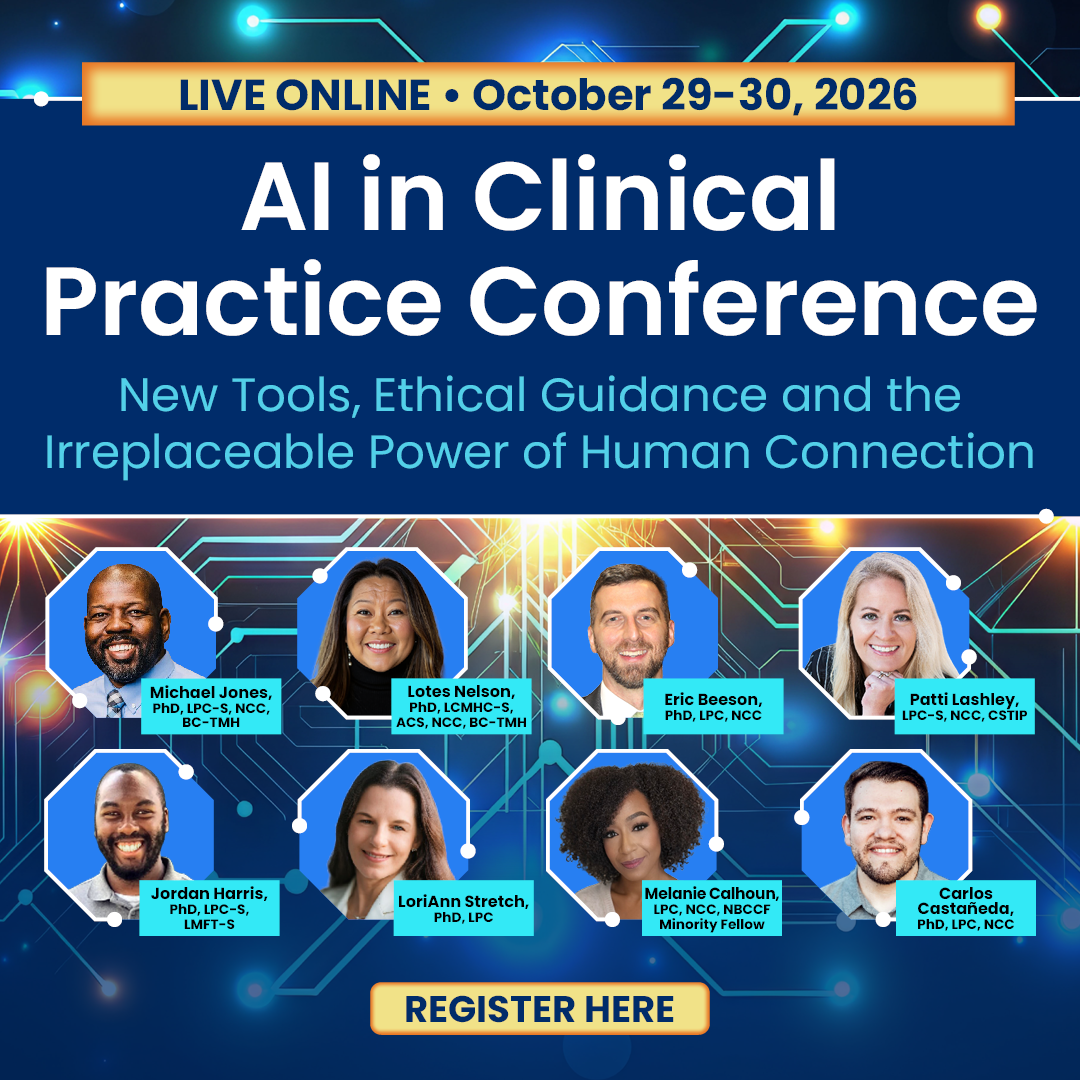
eCare Behavioral Health Institute · AI in Clinical Practice · 2026
NBCC Foundation Symposium · The Ethics of Influence: What Counselor Leaders Owe the Next Generation · New Orleans · 2026
International
European Branch of the ACA · Heidelberg, Germany · 2024
Hawaii International Conference on Education · Honolulu · 2025
American Counseling Association · Toronto, Canada · 2023
Teaching & Learning with AI International Conference · Orlando · 2025
Recent Scholarship
Hairston, Sutherlin, Jones, & Chambers · Relational-cultural supervision in a digital world: Centering multicultural competence and connection · Tennessee Counseling Association Journal · 2025
Jones, Cook, Shepard, & Jones · From isolation to integration: Cross-cultural collaboration in counseling research · Tennessee Counseling Association Journal · 2025
Voices
What students, colleagues, and audiences say.
“Such an incredible session… you made an impact on not only the attendees but hopefully some of their clients as well.”
PESI2026 Grief Summit team
“I have required your training as part of my master’s-level coursework for the past three years. It has been an incredibly valuable resource for my students.”
Dr. Sarah FlintClinical Coordinator, CMHC Program, Auburn University
“Professor Jones was exceptional… The field experience in this class helped me gain a better perspective to prepare myself for the real-world experiences I will have with my future clients.”
“His passion for counseling and for issues of diversity permeates his teaching… his enthusiasm for the content is contagious.”
Dr. Asha DickersonCounselor educator and colleague
“Your insights… resonated deeply with me. Your ability to connect evolving clinical practices with counselor education felt especially relevant.”
Darla PooleWoodall Conference Coordinator, Delta State University
“Michael Jones. Always.”
Conference AttendeeAsked to name their favorite speaker, ArCA
Upcoming Engagements
Where he's speaking next.
Black mental health runs through this schedule the way it runs through his work. He co-edited Mental Health and the Black Man: A Mixtape Experience of Hardship and Harmony, and this September he brings two sessions to the 10th Annual Black Mental Health Symposium.
2026
September 2026
Black Mental Health Symposium, 10th Annual Black Mental Health Algorithms Ain’t Neutral: Care Ethics, AI, and the Future of Black Mental Health · with Dr. Tiffanie Sutherlin · Virtual
September 2026
Black Mental Health Symposium, 10th Annual Black Mental Health Naming the Wound: Father Absence, Masculinity, and the Emotional Lives of Black Men · with David Awoyemi & Tameka Smith · Virtual
Arkansas Counseling Association Annual ConferenceBlack Mental Health Beyond the Stereotype: A Mixtape for Counseling Black Men · Keynote · Little Rock, AR
November 2026
SACES Regional Conference · Four sessions: two accepted, two invited · Louisville, KY
December 2026
eCare Behavioral Health InstituteTechnology · AI in Clinical Practice · Online
2027
January 21, 2027
PESIEthics Friend Requests and Ethical Wrecks: Navigating Social Media Boundaries and Dual Relationships · Online
January 29, 2027
PESIEthics Telehealth Update: Ethics, New Rules, and New Tools · Online
April 2027
F.E. Woodall Spring Conference, Delta State University · Keynote
November 2027
Illinois Counseling Association Annual Conference · Keynote
Interested in a similar session for your program? Start here.
Continuing Education
The Counselor Education Collective
Dr. Jones founded the Collective to give counselors CE worth their time: ethics-centered, current, and ready for clinical practice. Its flagship is the six-hour AI Care Ethics Certificate, an NBCC-approved certificate program built specifically for counselors and grounded in care ethics. Alongside it sits the 20-hour Telemental Health Provider Training, an approved preparation course for the national BC-TMH credential. University programs across the country partner with the Collective to bring its trainings to their students: Auburn University, South College and its nursing program, Mercy University, Carlow University, Monmouth University, the University of Nebraska at Omaha, Ouachita Baptist University, West Virginia Wesleyan College, and Cornerstone University.
Six-hour AI Care Ethics Certificate, NBCC-approved and built specifically for counselors
NBCC credit hours, built and taught by practicing clinicians
20-hour Telemental Health Provider Training covering all 78 BC-TMH content areas
Partnerships with nine university programs embedding trainings in counseling and nursing curricula
Cohort trainings and custom CE for programs and agencies
Consultation for faculty teams integrating telehealth, AI, or ethics into curriculum
Book & Media
Scholarship with a pulse.
New Book · 2026
Mental Health and the Black Man
A mixtape experience of hardship and harmony. Co-edited with Dr. S. Kent Butler and published by Cognella, this collection reimagines Black fatherhood, faith, freedom, and healing.
Co-editor of a special issue of The Professional Counselor on eliminating mental health disparities, with published work on AI ethics, telemental health, supervision, and biracial identity.
The Center for Credentialing & Education, the body behind the BC-TMH credential, featured Dr. Jones in its Credential Holder Spotlight series on his path from rural Arkansas clinician to national telemental health educator.
A weekly note on counseling, ethics, and the technology showing up in our work. Teaching ideas for therapists, supervisors, and counselor educators, a few things worth knowing, and an idea still in progress. A new issue lands every Monday, and it is free.